
A lot of business owners treat VAT registration as something to get to once things settle down. The Federal Tax Authority doesn’t see it that way. Once your taxable supplies cross AED 375,000 in any rolling 12-month period, you have exactly 30 days to apply. Miss that window and the cost is bigger than most people expect.
If you’re weighing up VAT registration Dubai requirements right now, or you suspect you’ve already crossed the threshold without registering, here’s what the penalty actually looks like and why the fixed fine is rarely the biggest part of the bill.
The AED 10,000 fine is just the starting point
Late registration carries a fixed penalty of AED 10,000. That figure hasn’t moved and applies uniformly, regardless of your business size or how long you’ve been over the threshold. It’s the number most people quote when they talk about VAT penalties, and it’s the one that gets attention because it’s simple.
What it doesn’t tell you is what comes with it.
The real cost: retroactive VAT
Once the FTA identifies a business that should have registered earlier, it backdates the registration to the date the threshold was actually crossed, not the date you eventually applied. That means you owe 5% VAT on every taxable supply made during the entire unregistered period, whether or not you ever collected that VAT from your customers.
Say you crossed the threshold 18 months ago and have invoiced AED 2,000,000 in taxable supplies since. You’re now looking at AED 100,000 in VAT liability, out of your own margin, on top of the AED 10,000 fixed penalty. Most businesses never priced VAT into those old invoices, so this amount comes straight out of profit rather than out of a customer’s pocket.
This is the part that catches people off guard. The fine is fixed and predictable. The retroactive liability is not, and it grows with every month you stay unregistered.
How the FTA actually finds unregistered businesses
The FTA doesn’t rely on businesses to self-report a missed deadline. It cross-references data from banks, customs records, and other government entities to flag companies operating above the threshold without a Tax Registration Number. Free zone companies are not exempt from this either. A common assumption is that free zone status puts a business outside UAE VAT law entirely, which isn’t correct. Free zone entities making taxable supplies above the threshold have to register the same as any mainland company, aside from certain goods movements inside designated zones.
Also Read – How to Find the Right Business Consultant in Dubai
If you’ve already missed the deadline
There’s a narrow relief route worth knowing about. If you complete registration and file your outstanding tax return or annual declaration within seven months from the end of your first tax period, the FTA will waive the late registration penalty, or refund it if you’ve already paid. This isn’t automatic. It requires you to actually get compliant within that window, and it’s exactly the kind of deadline a VAT registration consultant tracks on your behalf so it doesn’t slip past you while you’re focused on running the business.
Outside that window, a Voluntary Disclosure submitted before the FTA flags your file independently still puts you in a better position than waiting to be caught. Coming forward proactively is treated differently to being discovered through an audit, and the difference in outcome is significant enough that it’s worth acting the moment you realise you’ve crossed the threshold, rather than hoping it goes unnoticed.
Late payment is a separate, ongoing cost
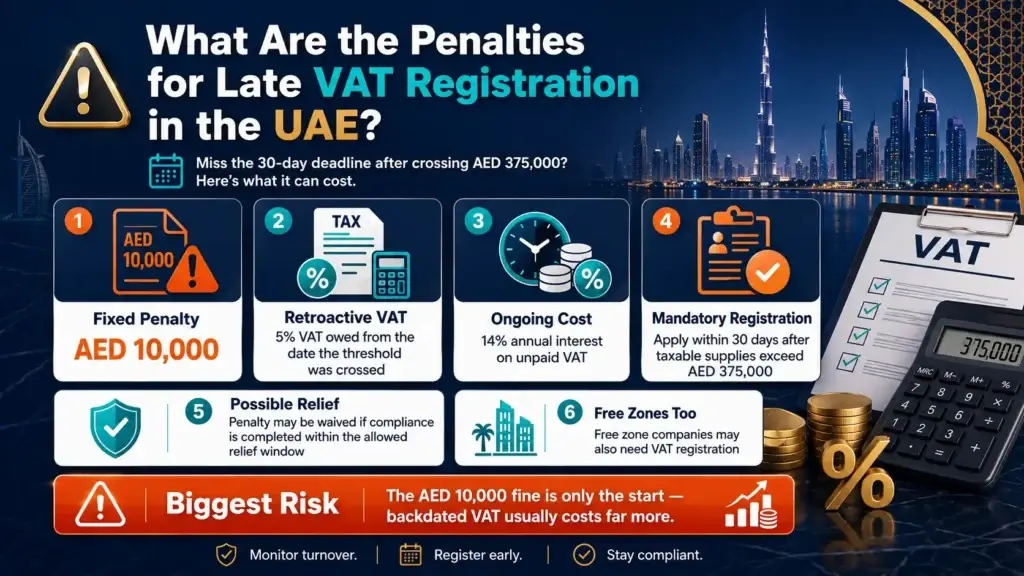
Late registration and late payment are two different penalties. As of the current framework under Cabinet Decision No. 129 of 2025, unpaid VAT accrues interest at 14% per annum, calculated monthly, from the day after the payment deadline until it’s settled. This replaced the older escalating percentage model. It applies regardless of whether the underlying tax comes from a normal filing or from a backdated registration, so a business that registers late is often facing the fixed penalty, the retroactive VAT, and ongoing interest on that VAT all at the same time.
Why this rarely stays a VAT-only problem
Businesses that miss VAT registration deadlines often have other compliance gaps sitting alongside it. Corporate tax registration carries its own separate AED 10,000 late penalty and its own filing deadlines, and the FTA runs both regimes through the same EmaraTax portal and the same data-matching systems. If VAT registration slipped past you, it’s worth checking your corporate tax position at the same time rather than treating them as unrelated. This is usually where corporation tax services and VAT compliance overlap in practice. A consultant reviewing one will almost always check the other, because the FTA does too.
Check the number before the FTA does
The AED 10,000 figure is what gets repeated, but it’s rarely the number that hurts. If there’s any doubt about whether your taxable supplies have crossed AED 375,000 over the past 12 months, run the calculation now. The FTA’s data matching will find it eventually either way, and the difference between registering voluntarily and being caught is measured in tens of thousands of dirhams, not paperwork.
Also Read – VAT Registration Dubai: New 5-Year Deadline Rule Every Business Must Know
Frequently Asked Questions (FAQs)
1. When is VAT registration mandatory in the UAE?
VAT registration becomes mandatory when a business’s taxable supplies and imports exceed AED 375,000 over the previous 12 months or are expected to exceed that threshold within the next 30 days. Businesses must submit their VAT registration application within the prescribed timeframe to avoid penalties.
2. What is the penalty for late VAT registration in the UAE?
Businesses that fail to register for VAT within the required deadline may face a fixed administrative penalty of AED 10,000. In addition, they may be required to pay VAT retrospectively from the date registration became mandatory, along with any applicable late payment charges.
3. Can the Federal Tax Authority waive the late VAT registration penalty?
Yes, in certain circumstances. The FTA provides relief where eligible businesses complete their VAT registration and comply with the applicable filing requirements within the prescribed timeframe under the relevant administrative penalty relief rules. Eligibility should always be verified against the latest FTA guidance.
4. Do free zone companies need to register for VAT?
Yes. Being established in a UAE free zone does not automatically exempt a business from VAT registration. If a free zone company exceeds the mandatory registration threshold and makes taxable supplies, it must register for VAT unless a specific exemption applies under UAE VAT legislation.
5. How does the FTA identify businesses that should have registered for VAT?
The Federal Tax Authority uses information from multiple government agencies and third-party sources, including customs records, banking data, licensing authorities, and other regulatory databases, to identify businesses that may have exceeded the VAT registration threshold.
6. What happens if I didn’t charge VAT before registering?
If your registration is backdated by the FTA, you may still be required to pay VAT on taxable supplies made during the unregistered period, even if you did not collect VAT from your customers. In many cases, this liability must be paid from the business’s own funds.
7. Is late VAT registration different from late VAT payment?
Yes. Late registration and late payment are separate compliance issues with different administrative consequences. Registering late may trigger a fixed penalty, while failing to pay VAT by the due date can result in additional charges and interest in accordance with the applicable UAE tax regulations.
8. Can I register for VAT voluntarily before reaching the mandatory threshold?
Yes. Businesses with taxable supplies or expenses exceeding the voluntary registration threshold (currently AED 187,500) may apply for voluntary VAT registration. Many businesses choose this option to recover input VAT and establish tax compliance early.
9. Does late VAT registration affect corporate tax compliance?
Although VAT and corporate tax are separate tax regimes, both are administered by the Federal Tax Authority through the EmaraTax platform. Businesses with one compliance issue should review their overall tax obligations to ensure they are meeting all applicable registration, filing, and payment requirements.
10. How can businesses avoid VAT registration penalties?
Businesses should regularly monitor their taxable turnover, maintain accurate accounting records, and track the mandatory registration threshold throughout the year. Seeking professional tax advice or conducting periodic compliance reviews can help identify registration obligations before penalties arise.
Also Read – Corporate Tax 101: 3 Critical Corporation Tax Services Every LLC Needs