

The UAE ran tax-free for so long that plenty of business owners still think of corporate tax as something that will eventually apply to them, someday, once things settle down. It already applies. Federal Decree-Law No. 47 of 2022 brought in a 9% rate on taxable income above AED 375,000, with 0% below that threshold, and the Federal Tax Authority has moved well past its early “educational” phase into active enforcement. Registration, filing, and record-keeping are no longer optional extras you get to once revenue justifies it.
This is where corporation tax services earn their fee. Not by making tax disappear, since that was never the pitch, but by keeping a business on the right side of deadlines and documentation that the FTA checks closely.
Registration is the first place people slip
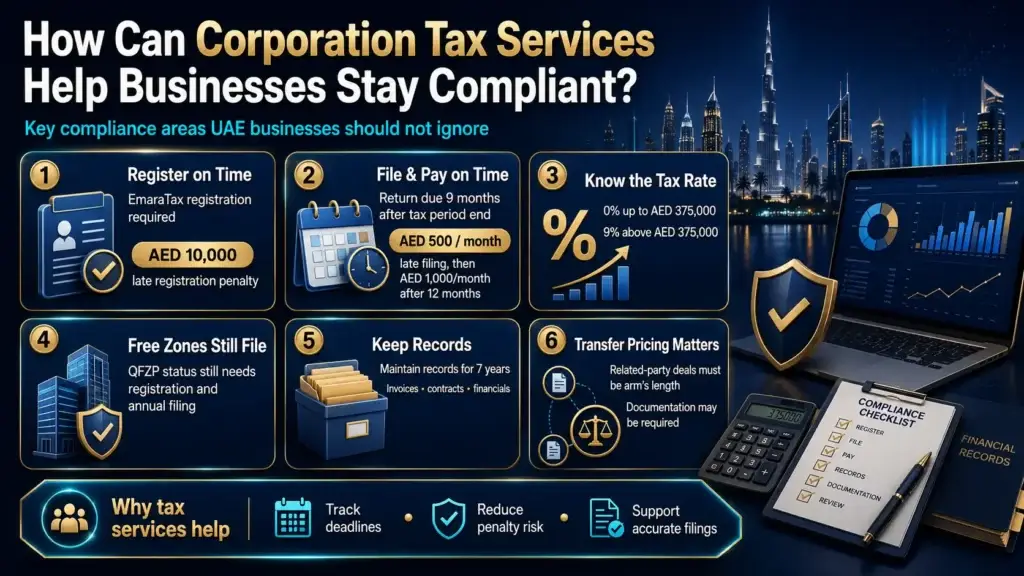
Every taxable person has to register for corporate tax with the FTA through the EmaraTax portal and get a Corporate Tax Registration Number. Businesses incorporated from March 2024 onward must register within three months of incorporation. Miss that window and the penalty is a flat AED 10,000, applied automatically, no warning first.
There’s a genuine relief measure worth knowing about: if a business missed its registration deadline but files its first corporate tax return or annual declaration within seven months of the end of its first tax period, the AED 10,000 penalty gets waived, or refunded if already paid. That’s a real second chance, but it has a hard cutoff. A tax service tracking this properly is often the difference between a business quietly fixing an early miss and one that pays a penalty it didn’t need to.
Also Read – Corporate Tax 101: 3 Critical Corporation Tax Services Every LLC Needs
Filing on time, every time
Once registered, the return is due nine months after the end of the tax period, and payment is due the same day. For a business with a calendar year ending December 31, 2025, that means both the return and any tax owed are due by September 30, 2026. There’s no provisional filing and no partial payment option; the FTA treats filing and paying as one obligation, so submitting a return without settling the tax still counts as non-compliant.
Late filing costs AED 500 a month for the first twelve months, rising to AED 1,000 a month after that. Late payment now accrues at 14% per year, charged monthly, following a rule change under Cabinet Decision No. 129 of 2025 that took effect in April 2026. None of this is negotiable through extensions. The FTA has said plainly that it doesn’t grant them.
A business filing on its own, especially for the first time, is working through audited financials, exemption calculations, and portal mechanics simultaneously, usually under deadline pressure. Corporation tax services exist to take that off a founder’s plate before the pressure turns into a missed date.
Free zone status doesn’t mean skipping the paperwork
This trips up more businesses than it should. A free zone company that qualifies for 0% tax as a Qualifying Free Zone Person still has to register and file annually, in full, on time. Qualifying for the preferential rate isn’t automatic once you’re in a free zone; it depends on meeting specific conditions around qualifying income, and the FTA has been paying particular attention to free zone filings where related-party transactions look underpriced, where the company doesn’t show real operating substance in the zone, or where the documentation supporting the 0% claim is thin. Get flagged on any of those and the business can lose QFZP treatment on all its income for the year, not just the disputed portion.
Records, transfer pricing, and the parts people forget
Financial records, invoices, contracts, payroll data, and anything supporting a claimed deduction or exemption need to be kept for seven years from the end of the relevant tax period. That’s a long window, and it’s easy for records to get disorganised across a company’s early years when nobody was thinking about a future audit.
Related-party transactions add another layer. UAE corporate tax law requires them to be priced at arm’s length, the same terms unrelated parties would agree to, and businesses with material related-party dealings need transfer pricing documentation on file and may have to submit a disclosure form with their return. This is one of the areas where the FTA’s scrutiny has visibly increased, and it’s not somewhere a business wants to improvise.
If an error turns up in a past filing, correcting it through a voluntary disclosure before the FTA finds it costs a fraction of what it costs if the FTA catches it first, roughly 1% a month against the disclosure versus 15% of the unpaid amount once the FTA discovers it independently. That gap alone makes proactive review worth the cost of a tax advisor.
Where this connects back to company formation
Tax compliance isn’t really a separate track from company formation in UAE; it’s downstream of it. The structure chosen at formation, mainland, free zone, or a group arrangement, shapes what corporate tax obligations look like from day one, and getting that structure wrong early tends to create tax complications later that are far more expensive to unwind than to plan for upfront.
For founders going through company formation, building the tax registration timeline, record-keeping habits, and QFZP eligibility checks into the setup process from the start avoids the scramble that happens when a business realises, nine months in, that it never actually confirmed its filing deadline. Corporation tax services aren’t just about avoiding fines. Done properly, they’re part of how a business stays structurally sound as it grows, rather than something bolted on after the FTA sends a notice.
Also Read – Business Setup in Dubai: Step-by-Step Guide for 2026
Frequently Asked Questions (FAQs)
1. What are corporation tax services?
Corporation tax services help businesses comply with the UAE Corporate Tax regime by assisting with tax registration, return preparation, tax calculations, filing deadlines, record-keeping, transfer pricing compliance, and responding to Federal Tax Authority (FTA) requirements.
2. Is corporate tax registration mandatory for all UAE businesses?
Most businesses and legal entities operating in the UAE are required to register for Corporate Tax with the Federal Tax Authority, even if they qualify for a 0% tax rate or do not currently have taxable income. Registration requirements depend on the entity type and applicable tax regulations.
3. What is the UAE corporate tax rate?
The UAE imposes 0% Corporate Tax on taxable income up to AED 375,000 and 9% on taxable income exceeding AED 375,000 for most businesses. Certain multinational enterprises may be subject to different rules under international tax frameworks.
4. Do free zone companies need to file corporate tax returns?
Yes. Qualifying Free Zone Persons (QFZPs) must still register for Corporate Tax and submit annual tax returns, even if they are eligible for a preferential 0% tax rate. Maintaining eligibility requires ongoing compliance with the relevant conditions prescribed under UAE Corporate Tax law.
5. How long must businesses keep corporate tax records in the UAE?
Businesses are generally required to retain accounting records, invoices, contracts, financial statements, and supporting tax documentation for at least seven years after the end of the relevant tax period, unless otherwise specified by the applicable legislation.
6. What happens if I miss the corporate tax registration deadline?
Missing the registration deadline may result in administrative penalties imposed by the Federal Tax Authority. However, eligible businesses that regularise their position within the prescribed relief period may qualify for penalty waivers or refunds, subject to the applicable FTA rules.
7. What is transfer pricing, and why is it important?
Transfer pricing refers to the pricing of transactions between related parties. UAE Corporate Tax rules require these transactions to be conducted on an arm’s length basis, meaning the terms should be comparable to those agreed between independent businesses. Certain businesses must also maintain transfer pricing documentation and disclosures.
8. Can a tax consultant help if I discover an error in a previously filed tax return?
Yes. A qualified tax consultant can assess the issue, determine whether a voluntary disclosure is required, and help correct the error in accordance with FTA procedures. Addressing mistakes proactively can often reduce compliance risks and potential penalties.
9. Are corporate tax and VAT compliance connected?
Although Corporate Tax and VAT are separate tax systems, both are administered by the Federal Tax Authority through the EmaraTax platform. Businesses should monitor compliance for both taxes to ensure registrations, filings, payments, and record-keeping obligations are met.
10. Why should startups and SMEs consider professional corporation tax services?
Professional tax advisors help businesses establish compliant accounting systems, monitor filing deadlines, maintain accurate records, identify available tax reliefs, and minimise the risk of penalties. This allows founders to focus on growing their business while ensuring ongoing tax compliance.
Also Read – VAT Registration Dubai: New 5-Year Deadline Rule Every Business Must Know