

Most guides make UAE company formation sound like a single event: pick a zone, get a license, done. In practice, it’s a sequence, and rushing a step is what causes a rejected trade name, a stalled bank account, or a corporate tax registration you forgot about until the penalty notice arrived. Here’s what the process looks like from the first decision to the point where your company is actually operational.
Step 1: Decide where you’re setting up
Before anything else, you’re choosing between mainland, free zone, and offshore. Mainland companies register with the Department of Economic Development (or its equivalent in each emirate) and trade freely across the UAE and internationally. Most professional and commercial activities now allow 100% foreign ownership on the mainland, closing much of the gap that used to exist with free zones. Free zones still bring their own advantages: tighter cost control, faster digital onboarding, and potential 0% corporate tax on qualifying income. But selling directly into the mainland market usually needs a distributor or a dual license. Offshore structures (JAFZA Offshore, RAK ICC) suit holding assets or international trade, not a physical UAE presence.
This decision shapes everything that follows, so it’s worth getting right before you touch a single form.
Step 2: Pick your business activity and legal structure
Your activity determines your license type, whether you need extra approvals from bodies like MOHRE, Civil Defence, or KHDA, and how many visas you’re eligible for. Company formation in UAE runs on precise activity codes, and a mismatch between what you actually do and what’s written on your license is one of the more common reasons banks push back later.
Alongside the activity, you settle on a structure. On the mainland, an LLC is the standard choice for most founders. In a free zone, you’re picking between a Free Zone Establishment (FZE) for a single shareholder or a Free Zone Company (FZCO) for multiple shareholders.
Also Read – How Does Company Formation in UAE Work for New Entrepreneurs?
Step 3: Reserve your trade name
The name has to be unique, free of religious or political references, and approved by the DED or the relevant free zone authority. This step is quick once your activity is settled, but a name that’s already taken or flagged for review can stall the whole timeline by a few days, so it’s worth having two or three backups ready.
Step 4: Get initial approval
This is the government’s formal “no objection” to your proposed business. It confirms the authorities have no issue with the activity, but it doesn’t let you start trading yet. You’ll need this in hand before you can draft your Memorandum of Association or sign any office lease.
Step 5: Prepare and submit your documents
At this stage you’re pulling together passport copies of all shareholders, a notarized Memorandum of Association, a board resolution appointing your manager or director, and, for certain regulated activities, a business plan. Documents executed outside the UAE need attestation and translation, and this is where first-time applicants often lose a week or two they didn’t budget for.
Step 6: Secure office space
Mainland companies generally need a physical office with an Ejari (or Tawtheeq in Abu Dhabi) registration. Free zones are more flexible, many offer flexi-desk or virtual office packages that satisfy licensing requirements at a lower cost. Keep in mind that your office type also caps your visa quota, so a flexi-desk that’s fine for licensing might not support the headcount you’re planning for next year.
Step 7: Pay the fees and collect your license
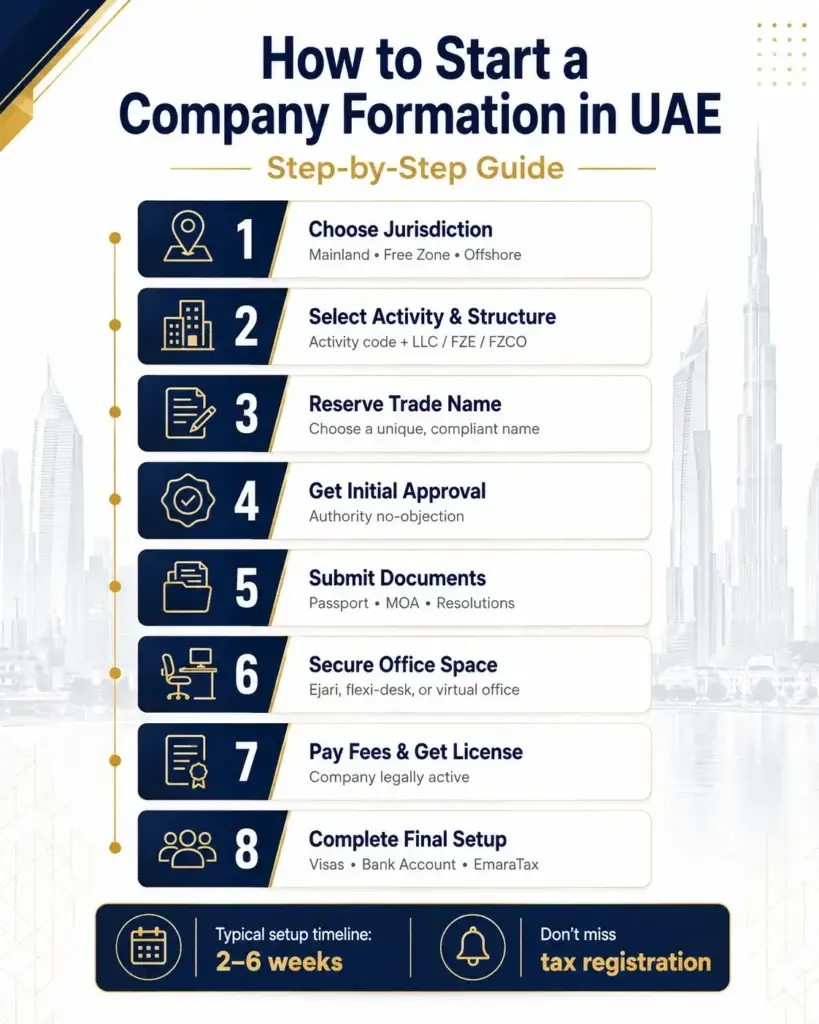
Once documents are approved and fees are settled, the license is issued and your company can legally operate. This is the milestone everyone focuses on, but it’s the midpoint of the process, not the finish line.
Step 8: Handle visas, banking, and tax registration
With your license live, you can apply for investor and employee visas through GDRFA, which includes medical testing and Emirates ID biometrics. Corporate bank account opening has become the most demanding part of the process in 2026, banks run detailed KYC checks and will ask for your trade license, shareholder details, and a clear description of your business model.
This is also where corporate tax comes in. Every company in the UAE, mainland or free zone, has to register with the Federal Tax Authority via EmaraTax, regardless of whether you expect to owe anything. Mainland companies with profits above AED 375,000 pay 9% corporate tax, while qualifying free zone companies may retain a 0% rate on qualifying income under the QFZP regime. Missing the registration deadline carries a flat penalty, so this isn’t a step to leave for later. Working with proper corporation tax services from the outset saves most founders from finding this out the expensive way.
The part that actually matters
None of these steps are hard on their own. What trips people up is sequencing, like starting a lease before initial approval. Get the order right and a standard UAE company formation runs two to six weeks. Get it wrong, and you’re re-doing paperwork you already paid for.
Also Read – VAT Registration Dubai: New 5-Year Deadline Rule Every Business Must Know
Frequently Asked Questions (FAQs)
1. What is the first step in starting a company in the UAE?
The first step is choosing the appropriate business jurisdiction—mainland, free zone, or offshore—based on your business activities, ownership preferences, target market, and operational requirements. This decision influences licensing, taxation, visa eligibility, and regulatory obligations.
2. How long does it take to complete company formation in the UAE?
The timeline depends on the chosen jurisdiction, business activity, and how quickly the required documents are submitted. For straightforward applications, company formation can often be completed within two to six weeks, while regulated activities may take longer due to additional approvals.
3. What documents are required to register a company in the UAE?
Typical requirements include valid passport copies of shareholders, passport-sized photographs, trade name approval, initial approval, constitutional documents such as the Memorandum of Association (where applicable), and proof of a registered business address. Additional documents may be required for regulated business activities.
4. Can a foreign national own 100% of a company in the UAE?
Yes. Many mainland business activities now permit 100% foreign ownership, and most UAE free zones have always allowed full foreign ownership. However, ownership rules may vary depending on the business activity and applicable regulations.
5. Do I need a physical office to start a company in the UAE?
Not always. Many UAE free zones offer flexi-desk or virtual office packages that satisfy licensing requirements. Mainland companies generally require a registered office, although approved business centres may provide compliant office solutions for eligible activities.
6. Is corporate tax registration mandatory after company formation?
Yes. Businesses operating in the UAE are generally required to register for Corporate Tax with the Federal Tax Authority through the EmaraTax platform, regardless of whether they ultimately pay Corporate Tax or qualify for a preferential tax rate.
7. Can I open a corporate bank account immediately after receiving my trade licence?
Once your trade licence is issued, you can begin the corporate bank account application process. However, UAE banks conduct detailed Know Your Customer (KYC) and compliance checks, so account approval timelines vary depending on the business activity, ownership structure, and supporting documentation.
8. What is the difference between a mainland and a free zone company?
Mainland companies can generally trade throughout the UAE without restrictions, while free zone companies benefit from simplified company formation, sector-specific business ecosystems, and potential tax advantages. However, free zone companies may face certain restrictions when conducting business directly in the mainland market.
9. What happens after my company is incorporated?
After incorporation, businesses typically complete post-registration formalities such as applying for investor and employee visas, opening a corporate bank account, registering for Corporate Tax and VAT (if applicable), and obtaining any additional permits required for their business activity.
10. Should I use a company formation consultant in the UAE?
While it’s possible to complete the process independently, many entrepreneurs choose to work with company formation consultants to avoid documentation errors, select the appropriate business structure, manage government approvals, and ensure compliance with licensing and tax requirements.
Also Read – Business Setup in Dubai: Step-by-Step Guide for 2026